Re-Roofing After Cyclone Pam
Challenge
Cyclone Pam tore through Vanuatu in 2015 flattening entire villages. A flagship hotel in the city of Port Vila fared better than most, but the uplifting of some of the already old and failing bituminous membrane on its flat roof rendered the need to replace it sooner than expected.
Solution
Viking Envrioclad F.B.S (fleece-backed-system) was suggested by Viking to be overlaid over the entire roof. A fleece-backed membrane is one with a factory-applied fleece on its underside; designed to ‘bed-in’and therefore forgive rough and uneven surfaces.
To begin, the applicator ensured all existing membrane was 100% fully-bonded; the cyclone left many loose membrane flaps. The loose flaps were cut-out and in-fill pieces of bituminous membrane were torched in their place. Viking Enviroclad F.B.S was then laid directly on top.
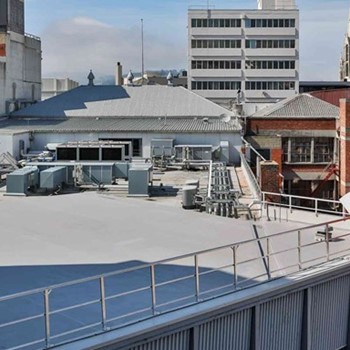
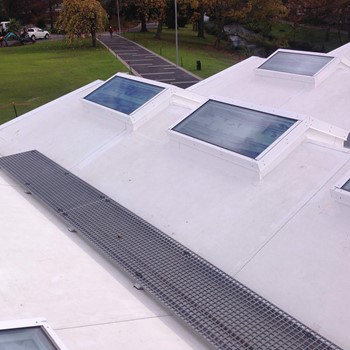
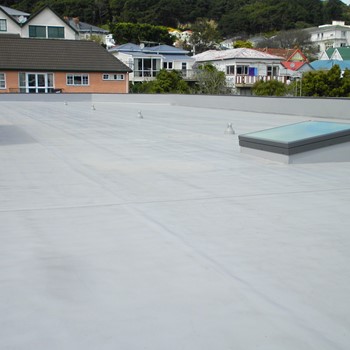
With its 3.6m wide x 30.4m long rolls, the membrane had few seams – minimising potential leak points. The seams are heat-welded to ensure 100% impervious joins. The light-grey surface also rendered a solar radiation reflectivity performance eight-fold higher than the old black bitumen; thus providing the building with unwanted extra heat.
The membrane was fastened to the existing surface using Dual Cartridge F.A.S.T. - a adhesive system which achieved maximum wind uplift resistance, protection against further storms.
Solution
After being damaged by Cyclone Pam, the resort now has a membrane roof that is not only water-tight, but significantly superior in specification to the membrane that was there before. With the roof area being 2200m2, avoiding substrate replacement meant precious savings in time and expense. It has superior solar reflectivity; minimal seams which are heat-welded; maximum wind uplift resistance thanks to the F.A.S.T. adhesive system, but most importantly – it’s now water-tight. The new membrane roof will protect the building from the elements for at least 20-years – the period of the product warranty protecting the membrane.